Saying no without saying no
You suggest an idea and hear "I'll have a think."
It may be a real pause, or a softer way of not committing. Flat refusals can feel rude, so look for whether a next step follows.
Try"Shall I check back next week?"
Cultural fluency
The unwritten rules of life in Britain.
Sharing a language is a start. Understanding the humour, habits and unwritten expectations takes longer. Explore the expressions, everyday habits and social cues that help Canadians feel more at home in Britain.
These are possible meanings, not fixed translations. Tone, context, region, age and the person all change what's meant. When in doubt, asking is fine.

Decode intentions, invitations and tone. Open a phrase for possible meanings, context and a useful reply. These are clues, not secret rules about what someone really thinks.
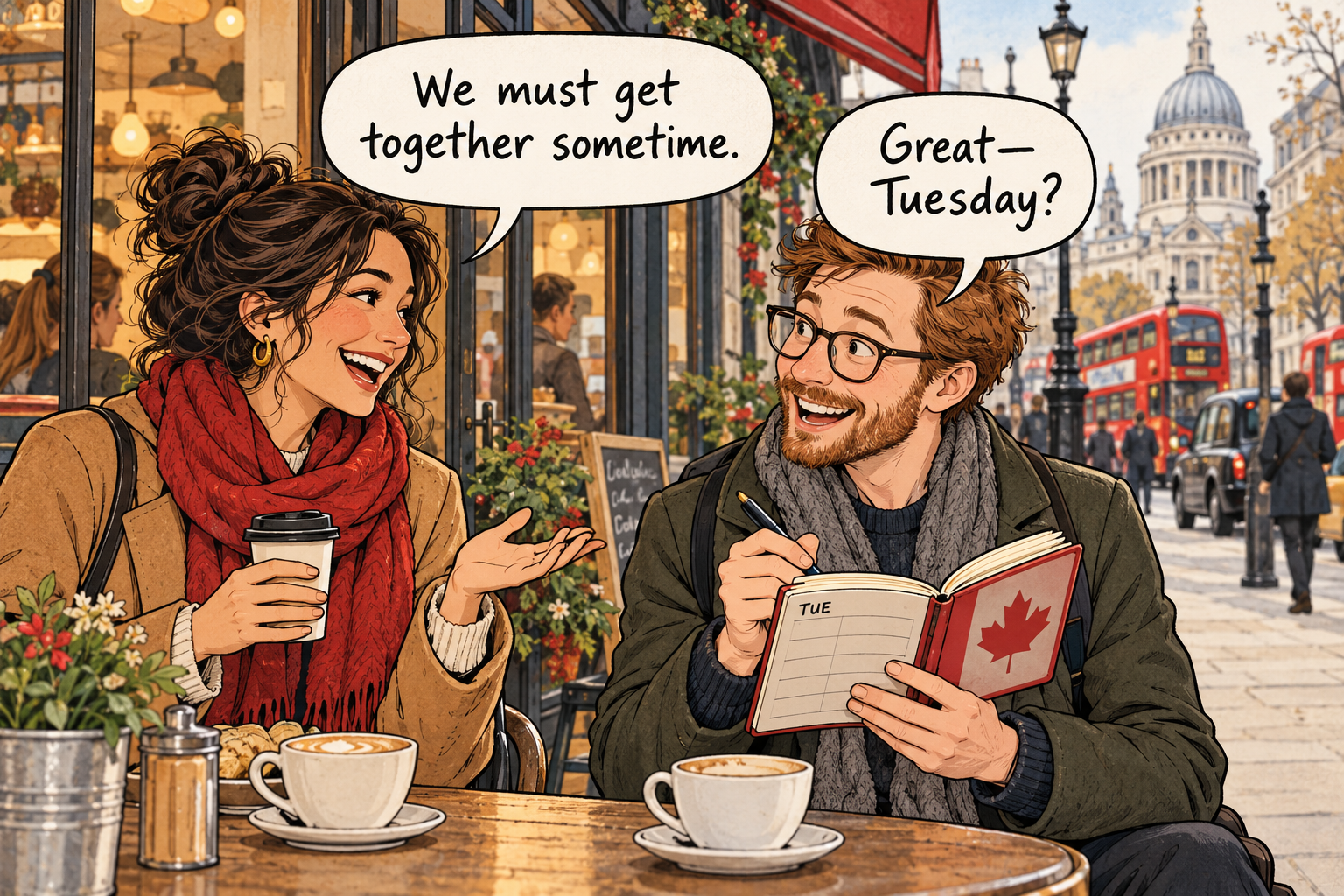
“Sometime” expresses friendly intent, but doesn’t fix a date. Suggesting one is fine; see whether a plan follows.
What can I say back?
“Would next Tuesday work?”
Looking for a word rather than a social cue? Explore British slang and double meanings, Cockney rhymes, money slang, dating and banter or pub etiquette.
When you can't tell which meaning you're getting, a light follow-up usually clears it up.
Some are everyday staples; others are colourful classics. You don’t need to adopt them all; recognising them is enough.
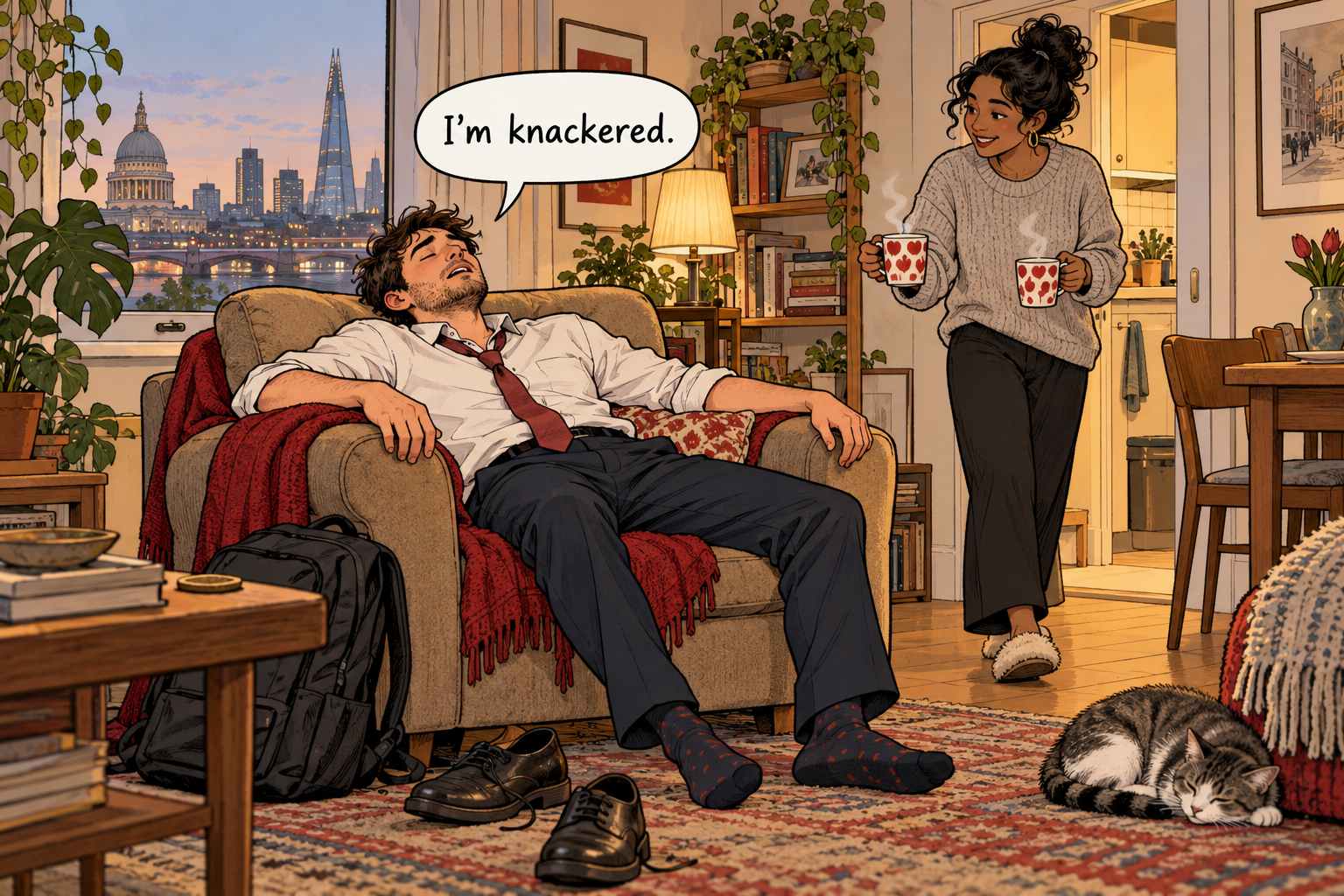
“Knackered” means exhausted. You might also hear “shattered”; both fit the end of a very long day.
What can I say back?
“Put your feet up. I’ll put the kettle on.”
“I'm really chuffed I got the job.”
Informal; usually positive.
“I'm gutted we missed the concert.”
Informal; stronger than mildly disappointed.
“Changing trains three times is a bit of a faff.”
Informal; useful for everyday frustrations.
“£15 for that? They're taking the piss.”
Taking the piss is vulgar; taking the mickey is milder.
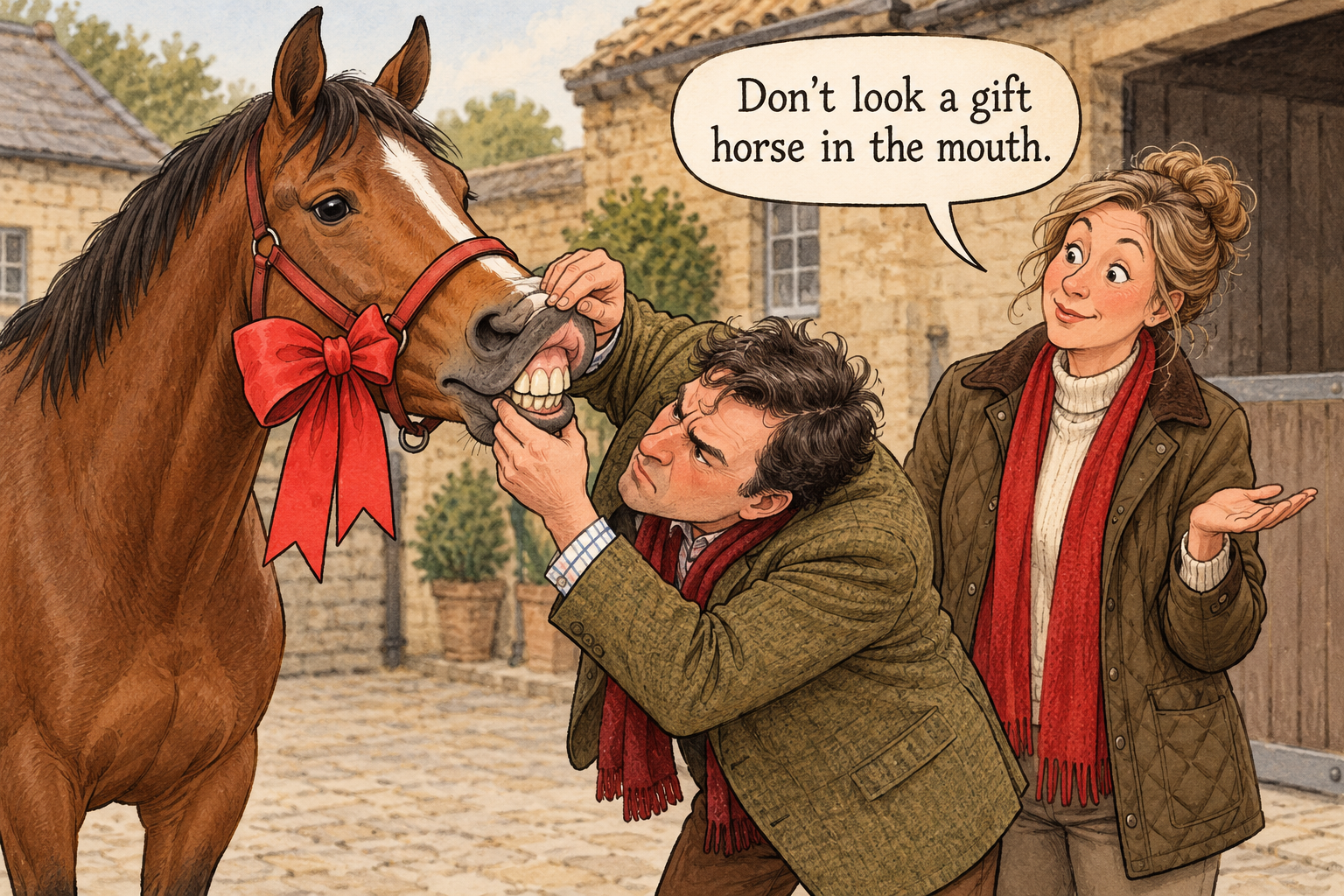
Appreciate a gift rather than finding fault with it. The joke here: a free sofa, a questionable colour, and a horse wondering why its teeth are involved.
In everyday conversation
“The sofa isn't my favourite colour, but it was free, don't look a gift horse in the mouth.”
“They expected him to keep a stiff upper lip.”
An older ideal of emotional restraint, not advice that you must hide your feelings.
“Blimey, that was quick!”
Colourful; cor blimey can sound old-fashioned or theatrical.
“Turn the key, press start, and Bob's your uncle.”
Playful; often follows simple instructions.
“How are things? Oh, mustn't grumble.”
Often gently humorous or understated.
For “a load of old pony” and the rhyme behind it, visit Cockney rhyming slang.
When something is hilarious or just too unlikely to believe.
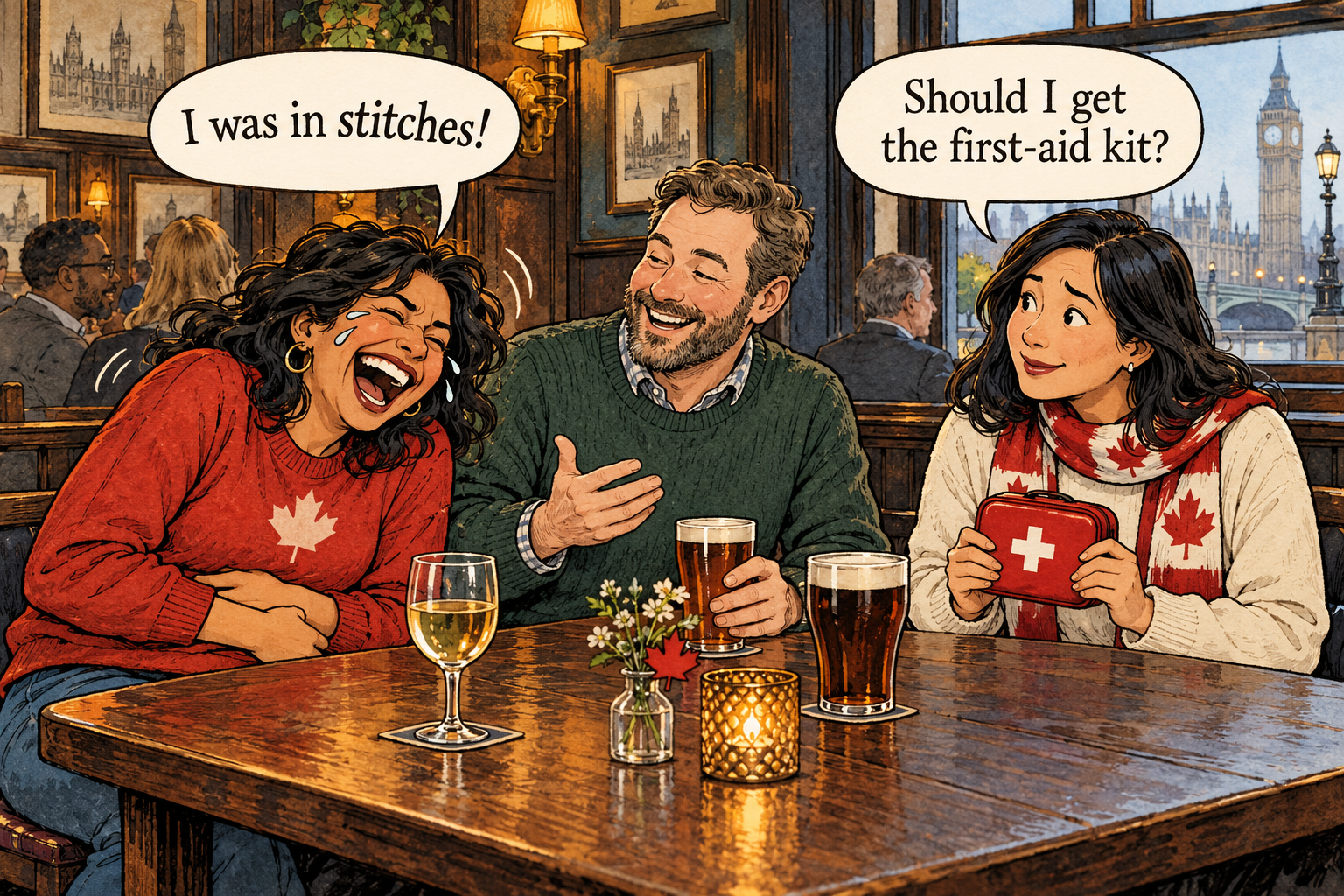
“I was in stitches” means something made you laugh a lot. No first-aid kit required.
“That story had me in stitches.”
It had me in stitches describes the cause; I was in stitches describes your reaction.
“He was so serious; I couldn't keep a straight face.”
Often used when laughing would be awkward.
“She's a right laugh. / We had a right laugh.”
Right intensifies the phrase here.
“You used to play for England? Pull the other one!”
The theatrical longer version is pull the other one, it's got bells on.
From a small irritation to losing your temper. Recognising these is useful; calling someone stroppy or shirty can make things worse.
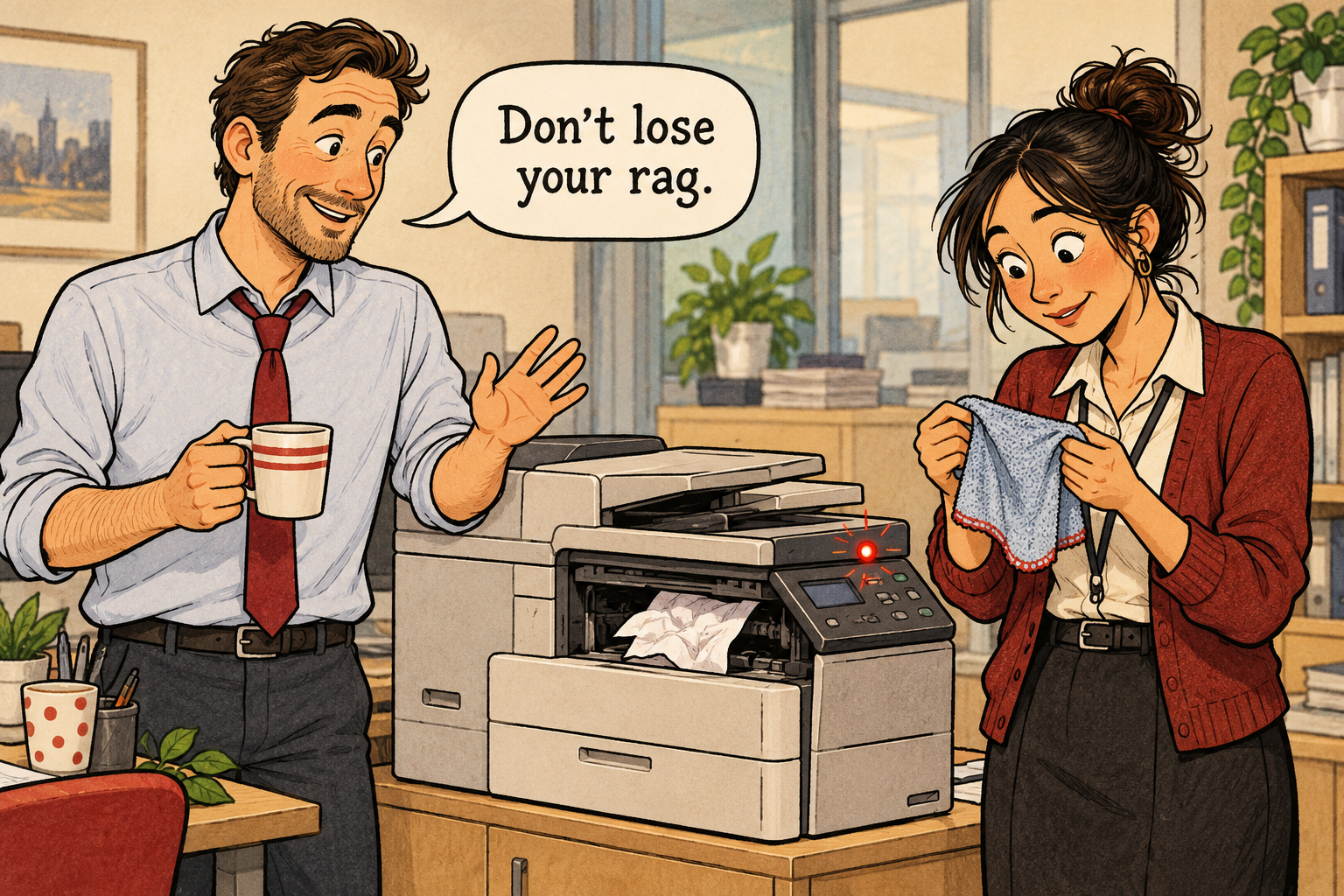
“Lose your rag” means lose your temper. The printer might be testing your patience, but nobody is asking where you left the cloth.
What can I say back?
“I'm trying not to! Let's take a minute.”
“That notification sound gets on my wick.”
Informal; a complaint rather than a literal reference to a candle.
“He lost his rag when the printer jammed again.”
Telling someone not to lose their rag can sound dismissive when they're already upset.
“No need to get stroppy, I only asked.”
Often critical; using it about someone may make a disagreement worse.
“She got a bit shirty about the seating plan.”
Informal and mildly disapproving.
A few words that can send a conversation in an unexpected direction.
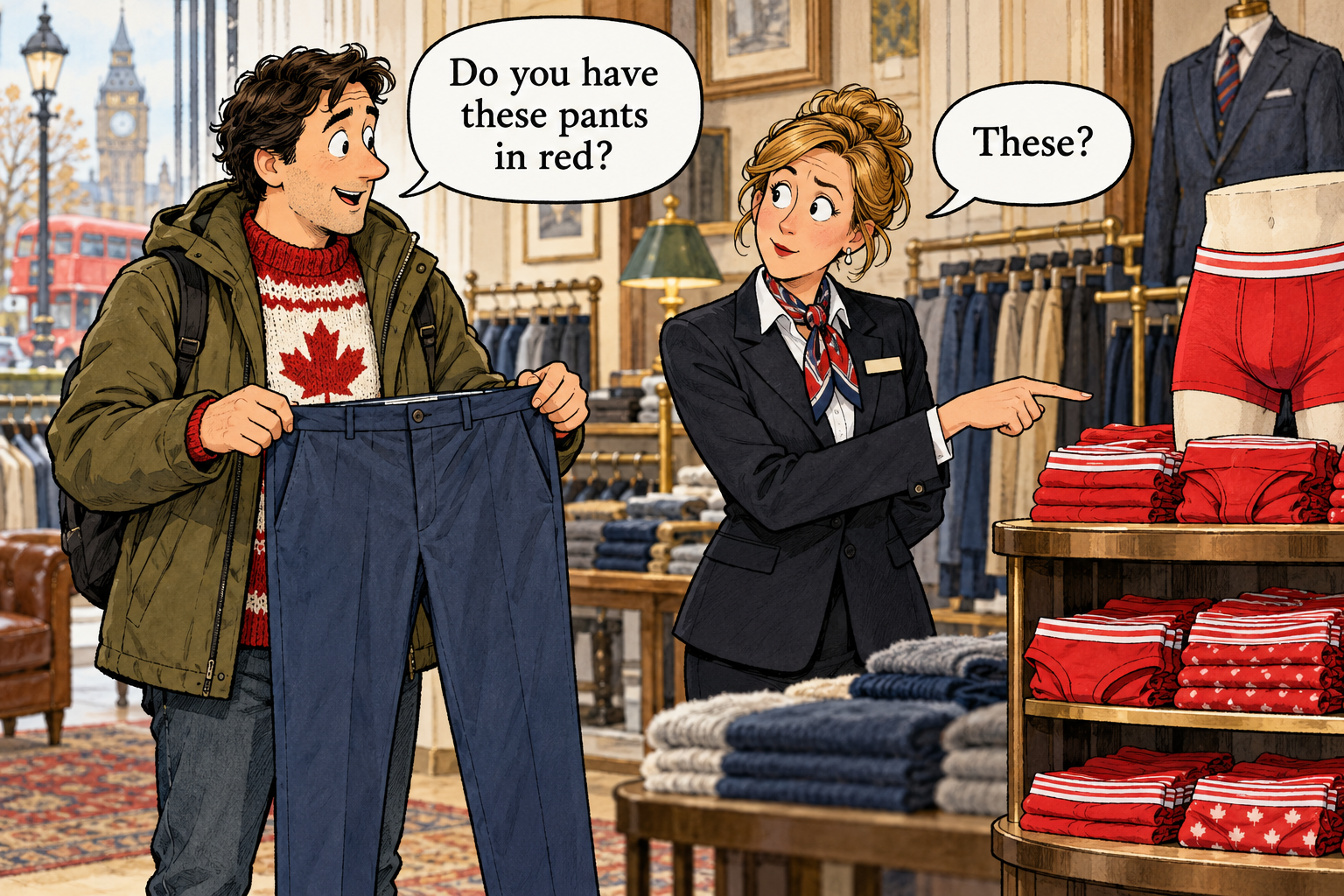
In Canada, pants usually means trousers. In Britain, it commonly means underwear. The clothes are familiar; the labels can catch you out.
“That's pants.”
As a judgement, this also means something is rubbish. Usage varies by region.
“He was pissed after the party.”
Both are informal and can be rude.
“Could I borrow a rubber?”
The North American condom meaning can cause confusion.
“Where can I buy a bum bag?”
Bum bag is the familiar British term for a fanny pack.
These are useful to recognise, especially where Canadian and British meanings differ.
Can mean a cigarette in British conversation: “Nipping out for a fag.” It is also an offensive anti-gay slur. Recognise the cigarette meaning in context; don't use it to refer to a person.
Vulgar slang for sex, used as a noun or verb. “Shag carpet” is still a normal description of a carpet.
Can mean prepare something quickly (“knock up a meal”), practise before tennis, or, in older usage, wake someone by knocking. The pregnancy meaning is also understood in Britain, so context matters.
British slang for seeking sexual encounters in public toilets, traditionally between men. For the Canadian holiday meaning, “going to the cottage” or “a weekend at the lake” is clear. Going to the cottage is perfectly normal wording.
British slang for sexual activity in public or secluded outdoor places, often with others watching. If you mean exercising your dog, say “walking the dog”.
British slang for a sexual encounter. It can also mean a physical boost, such as helping someone climb over a wall.
“Give me a bunk-up so I can see over the wall.” Context matters; the sexual use is informal and coarse.
You may hear these instead of a price in pounds. Quid, fiver and tenner are everyday staples; score, pony and monkey have more of a traditional slang flavour.
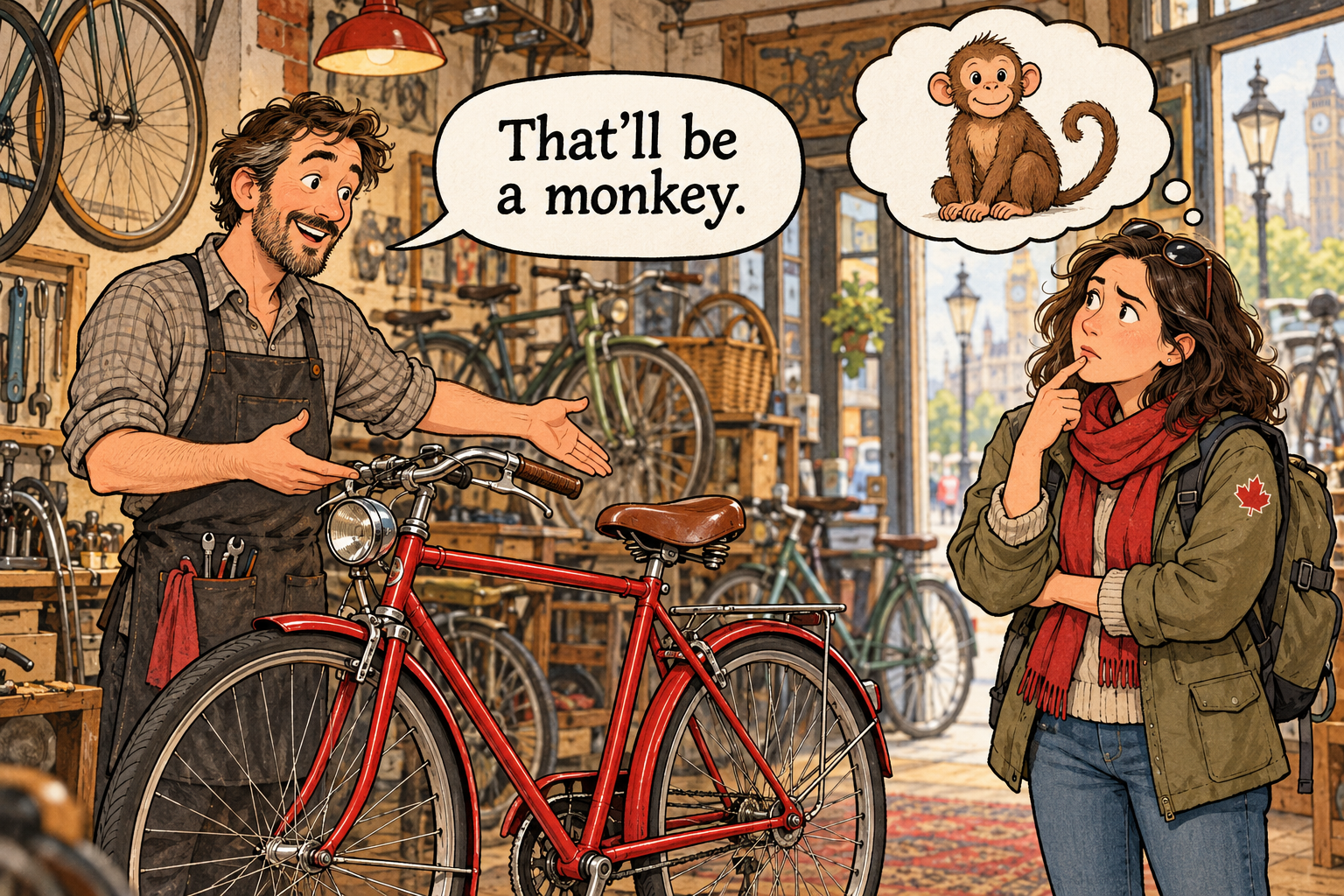
In traditional money slang, a monkey is £500, a pony is £25 and a score is £20.
What can I say back?
“Just to check, you mean five hundred pounds?”
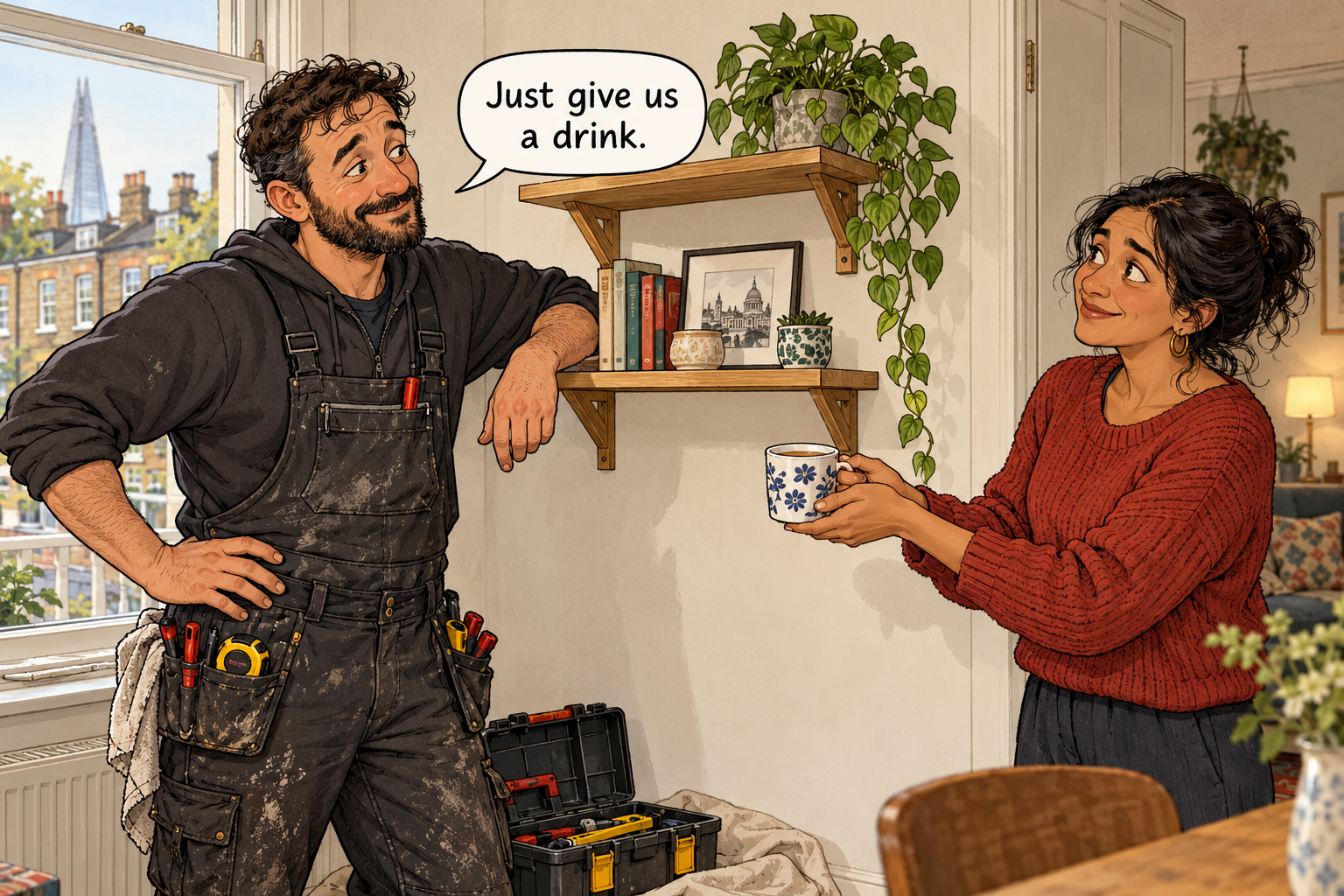
After a favour or small job, “a drink” can mean a payment. There’s no standard amount, so ask rather than guess.
What can I say back?
“How much did you have in mind?”
“It cost twenty quid.”
Say five quid, never five quids. Quid stays the same in the plural.
“Can you lend me a fiver?”
Usually means five pounds, often a £5 note.
“I'll give you a tenner for it.”
Everyday informal language.
“The ticket cost me a score.”
Traditional slang; score also means twenty outside money contexts.
Exactly the right question if you're unsure. Slang can vary by context; confirm the amount before agreeing to pay.
The chippy, the sparks and a quick tosh over. Decode the trade talk before agreeing what needs doing.
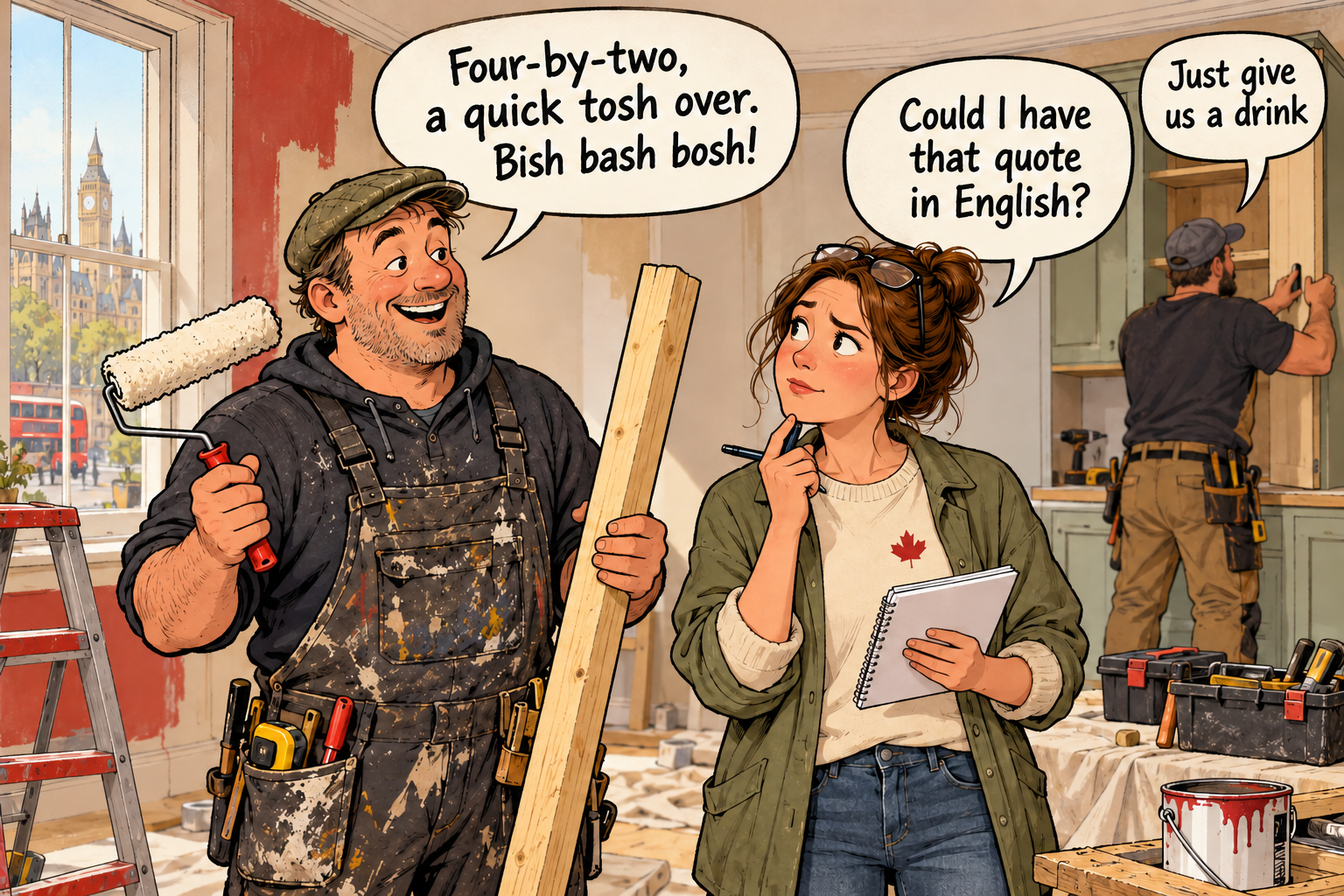
Different trades, familiar jobs and a whole new set of nicknames.
What can I say back?
“Can you write down what’s included and the total price?”
“We need a length of four-by-two.”
Nominal sizing shorthand. Check the actual dimensions and specification when buying.
“Bit of filler, coat of paint, bish bash bosh.”
Suggests speed and confidence, not necessarily poor workmanship.
“The chippy’s hanging the doors.”
Also a fish-and-chip shop. Context does the work.
“The sparks is coming on Tuesday.”
Informal trade nicknames.
Talking payment? See dosh, quids in and “give us a drink” in Talking money.
From a quiet “I fancy you” to a spectacularly cheesy chat-up line. Here's what you might hear and how it could land.
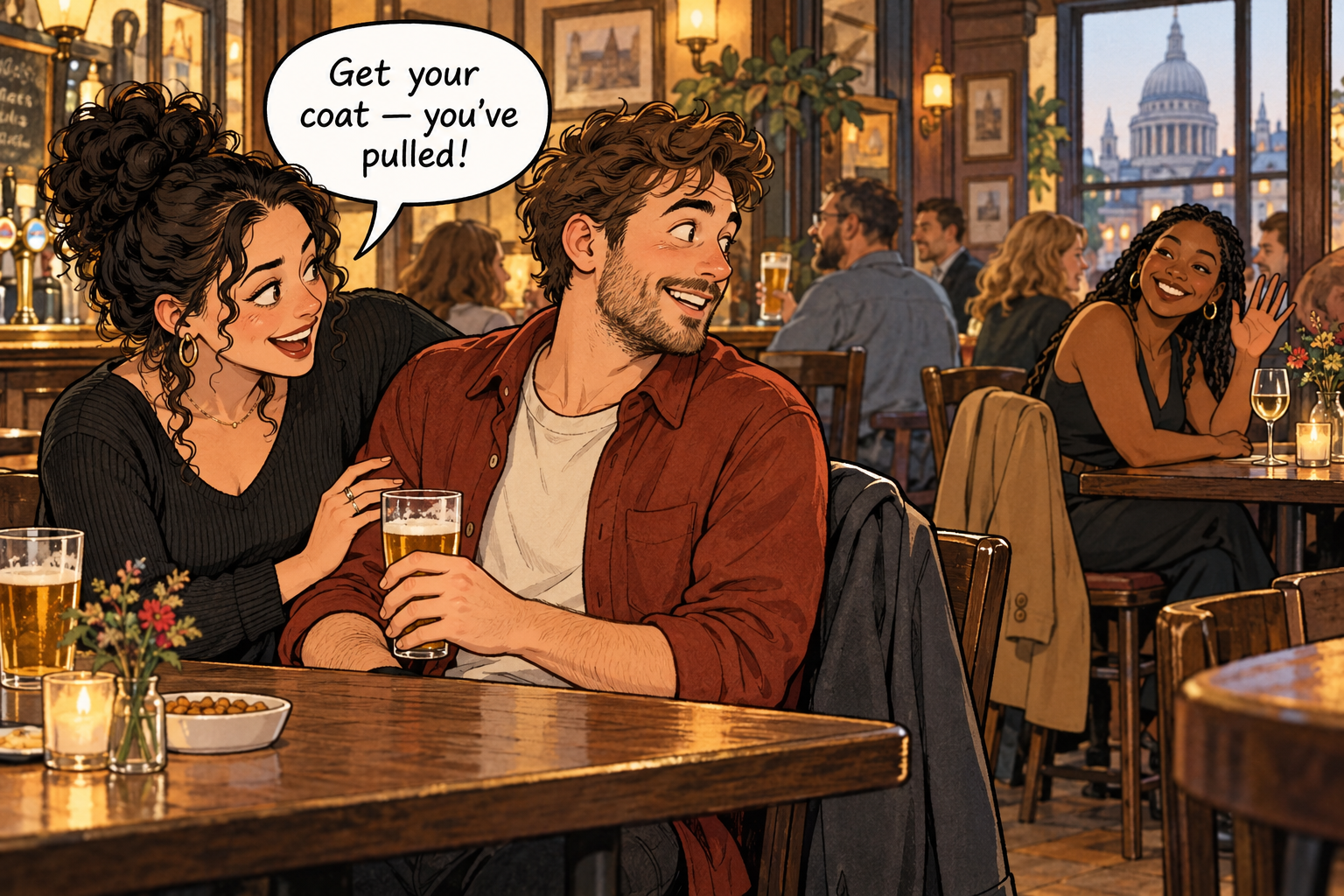
A cheeky, rather dated way of saying someone seems interested. It’s your friend’s interpretation, not a guarantee.
What can I say back?
“I’ll go and say hello.”
“I fancy you” expresses attraction. “Fancy a drink?” means “Would you like a drink?” It could be friendly or flirtatious; the words alone don't settle it.
And “we're going out” can mean “we're a couple” or simply “we're leaving the house”. Context does a lot of work.
“Someone's been flirting with you all evening. Your friend whispers: Get your coat, you've pulled!”
Jokey and rather dated; also a deliberately cheesy chat-up line. Pulled doesn't necessarily mean sex happened.
“I think she fancies you.”
Everyday informal language. Fancy a drink? simply asks whether you'd like one; it isn't automatically flirting.
“Are you chatting me up?”
Can be playful or direct, depending on delivery.
“They're going out on the pull tonight.”
Cheeky and informal; says something about their intentions, not anyone else's.
A friend's joke isn't confirmation of someone else's interest. If you're unsure, a simple “Would you like to go out sometime?” beats trying to decode everything.
Part language puzzle, part local humour. Associated with London's East End, rhyming slang replaces a word with a phrase that rhymes and often drops the very word that makes the rhyme obvious.
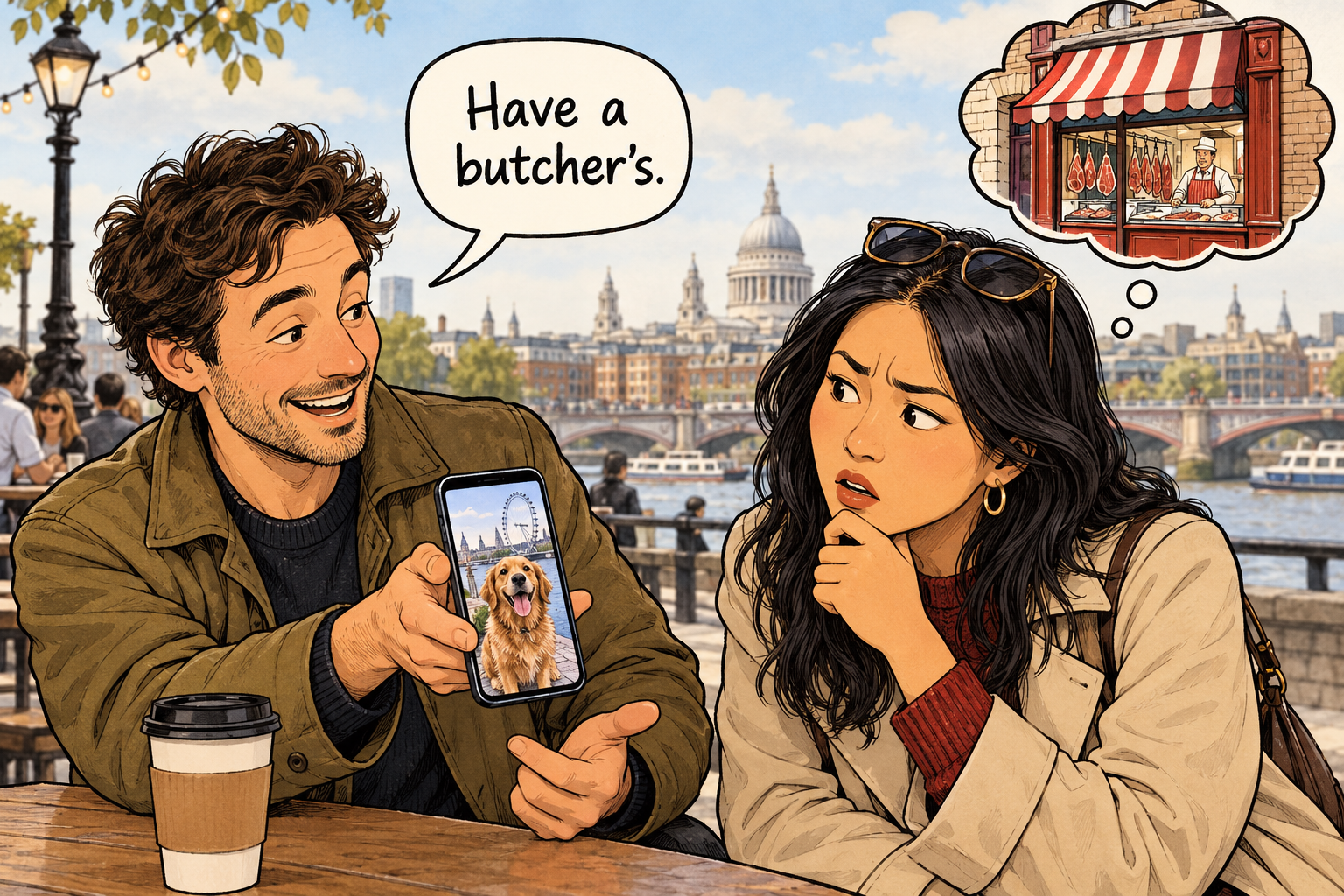
Butcher’s hook rhymes with look. Drop “hook” and the clue disappears: “have a butcher’s” simply means have a look.
What can I say back?
“Let’s have a look, then.”
Look → butcher's hook → butcher's. Remove “hook” and the clue disappears. That's why guessing from the words alone can be tricky.
Some expressions have travelled well beyond London. Others are traditional, regional or used mainly for a laugh. You don't need to speak in rhymes to fit in.
“Have a butcher's at this photo.”
Often shortened to butcher's; informal.
“Use your loaf, we can take the bus.”
Means use your head; can sound impatient.
“Are you telling porkies?”
Playful, but still an accusation of lying.
“I need to get my barnet cut.”
Informal and often humorous.
Explore more: Cockney Rhyming Slang dictionary and how the rhymes work.
Sometimes we're the ones who need translating. Canadian usage varies too; these won't be everyone's everyday words.
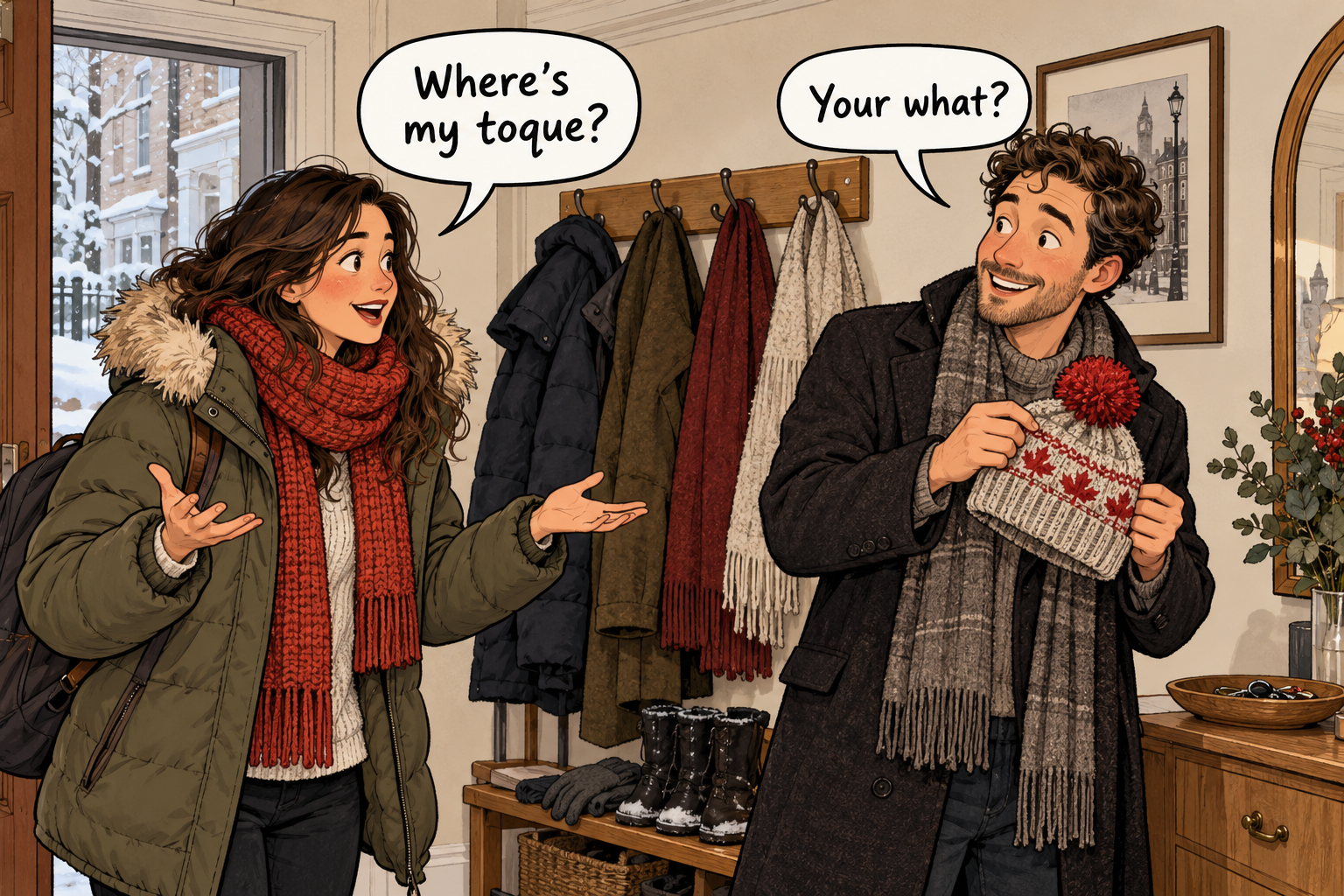
A familiar Canadian word can leave a British friend guessing. “Woolly hat” or “beanie” usually clears this one up.
What can I say back?
“My woolly hat, the one you’re holding!”
“Where are the toilets, please?”
Washroom may be understood, but toilets is clearer.
“Have you seen my woolly hat?”
A very Canadian word; spelling and pronunciation may need explaining.
“We brought a case of 24.”
Not a familiar British pack-size term.
“Coffee with cream and two sugars, please.”
Explain the order; British cafés don't generally use the Canadian shorthand.
Canadian shorthand for homogenised milk, usually 3.25% milk fat. In Britain, ask for whole milk. Outside that Canadian grocery context, the shortened word can be heard as an anti-gay slur.
The moment, what might be happening, and what you can say or do.
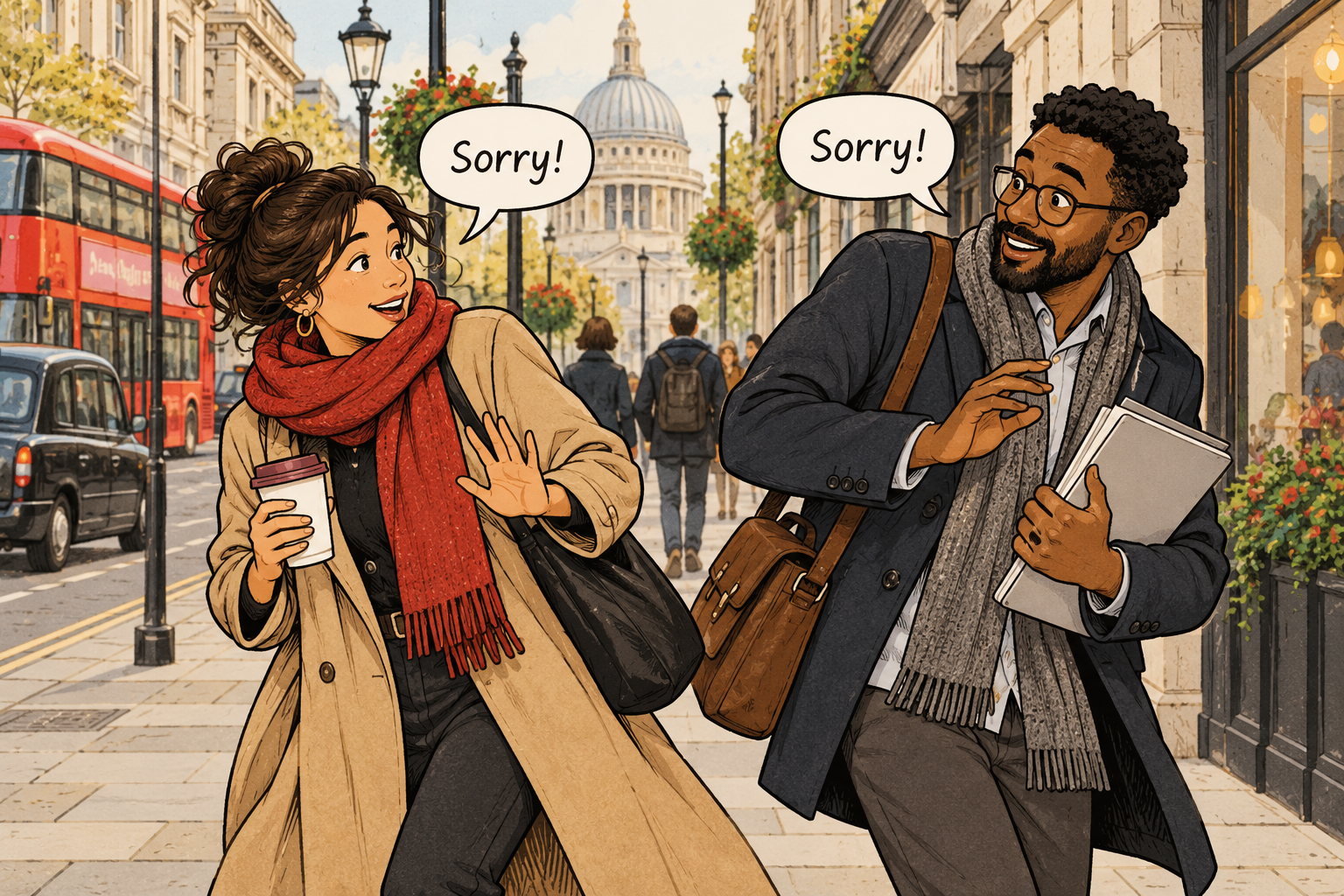
“Sorry” can smooth a small awkward moment without anyone working out who was at fault. Canadians may feel quite at home with this one.
What can I say back?
“No worries!”
You suggest an idea and hear "I'll have a think."
It may be a real pause, or a softer way of not committing. Flat refusals can feel rude, so look for whether a next step follows.
Try"Shall I check back next week?"
A colleague passes your desk: "Alright?"
Usually a greeting in passing. Tone and context matter: if someone pauses and asks with concern, it may be a genuine question.
Try"Yeah, good, you?" and carry on.
Someone calls a real setback "a bit of a nuisance".
Language is often dialled down. "Not bad" can be positive and "a bit of a problem" can be serious. Read the reaction relative to the person.
Try"How big a problem is it for you?"
Your proposal is called "interesting".
It could be genuine interest, uncertainty or polite disagreement. The word alone won't tell you which.
Try"What would make it work for you?"
Someone bumps into you, and you both apologise.
"Sorry" can be an apology, "excuse me", "pardon?" or a polite objection. Said with a rising tone, it usually means they didn't hear you.
TrySay sorry back, or repeat what you said.
A busy pub bar, with no visible line.
There's often still an order, and people notice who was waiting first. Queue-jumping tends to get a reaction.
Try"I think you were before me."
A colleague makes a gentle joke at your expense.
Irony and teasing are common and can express familiarity. You don't have to tolerate anything that makes you uncomfortable, whatever it's called.
TryLaugh it off if it's fine with you. If not, "Not my kind of joke" is enough.
"We must get together sometime."
Friendly, but not yet a plan. Treat it as unconfirmed until there's a day attached.
Try"I'd like that. Are you free next week?"
A stranger at the bus stop: "Grim out, isn't it?"
A low-stakes way to start a conversation. Nobody needs you to care about the forecast.
Try"Awful. Typical, though."
You give a straightforward "No, that won't work" and the room goes quiet.
What sounds efficient to you can sound abrupt, especially with people you don't know well yet.
Try"I'm not sure that'll work, because…"
Feedback is often softer on the surface and firmer underneath. Workplaces vary a lot, so take these as starting points.
Four familiar moments. Choose a scene to see the joke and what you can say back.
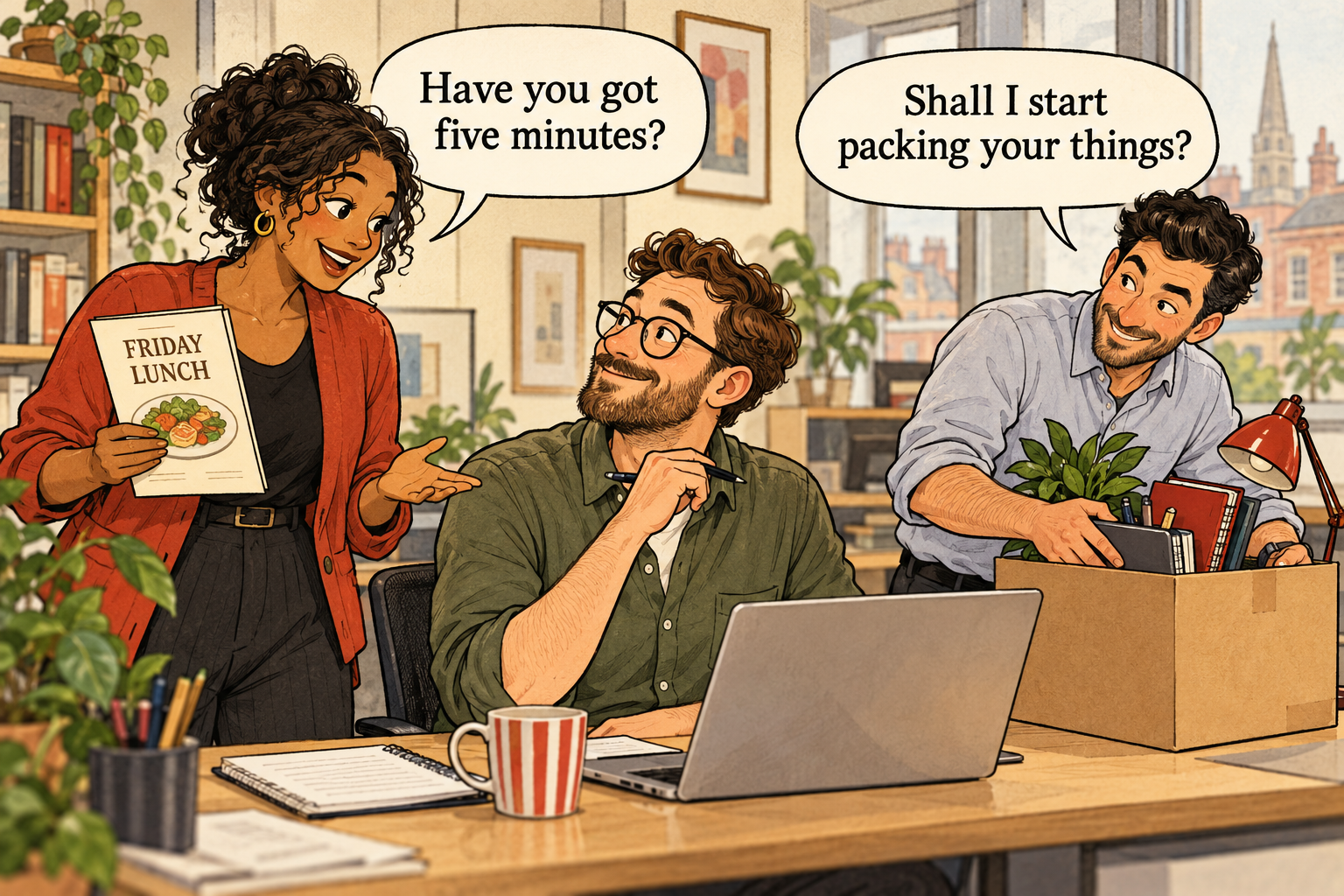
A quick chat can be routine, friendly or serious. Jokes about HR or packing your things play on that uncertainty; the phrase itself doesn’t mean you’re in trouble.
What can I say back?
“Of course, what’s it about?”
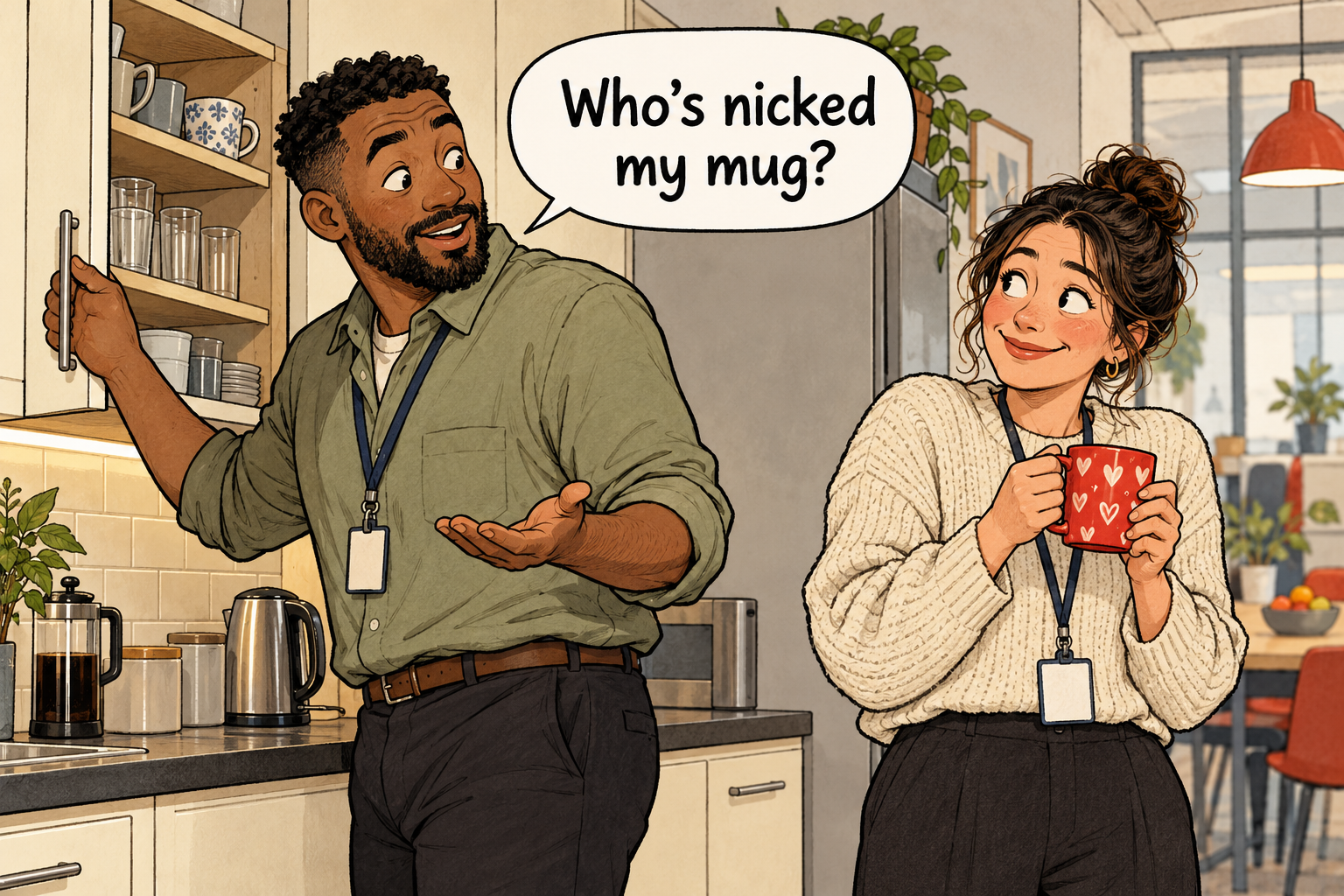
Nicked means taken or stolen. In an office kitchen, it’s often a jokey complaint about borrowing. A shared cupboard can still contain someone’s very personal mug.
What can I say back?
“Oh, is this yours? Sorry, I’ll wash it up.”
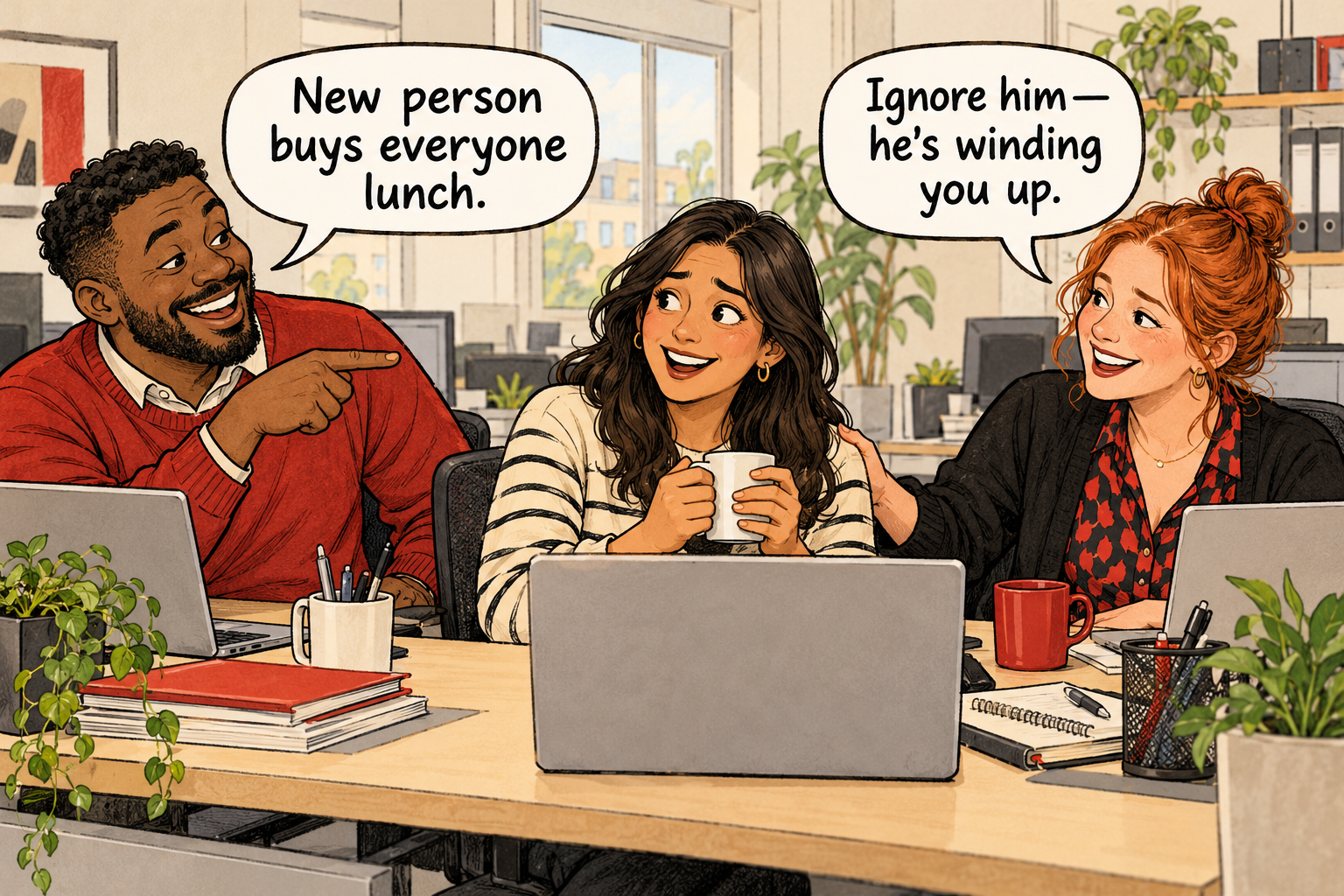
Winding you up means teasing or trying to get a reaction. You’re not foolish for taking something literally and you don’t have to enjoy every joke.
What can I say back?
“You had me there!”
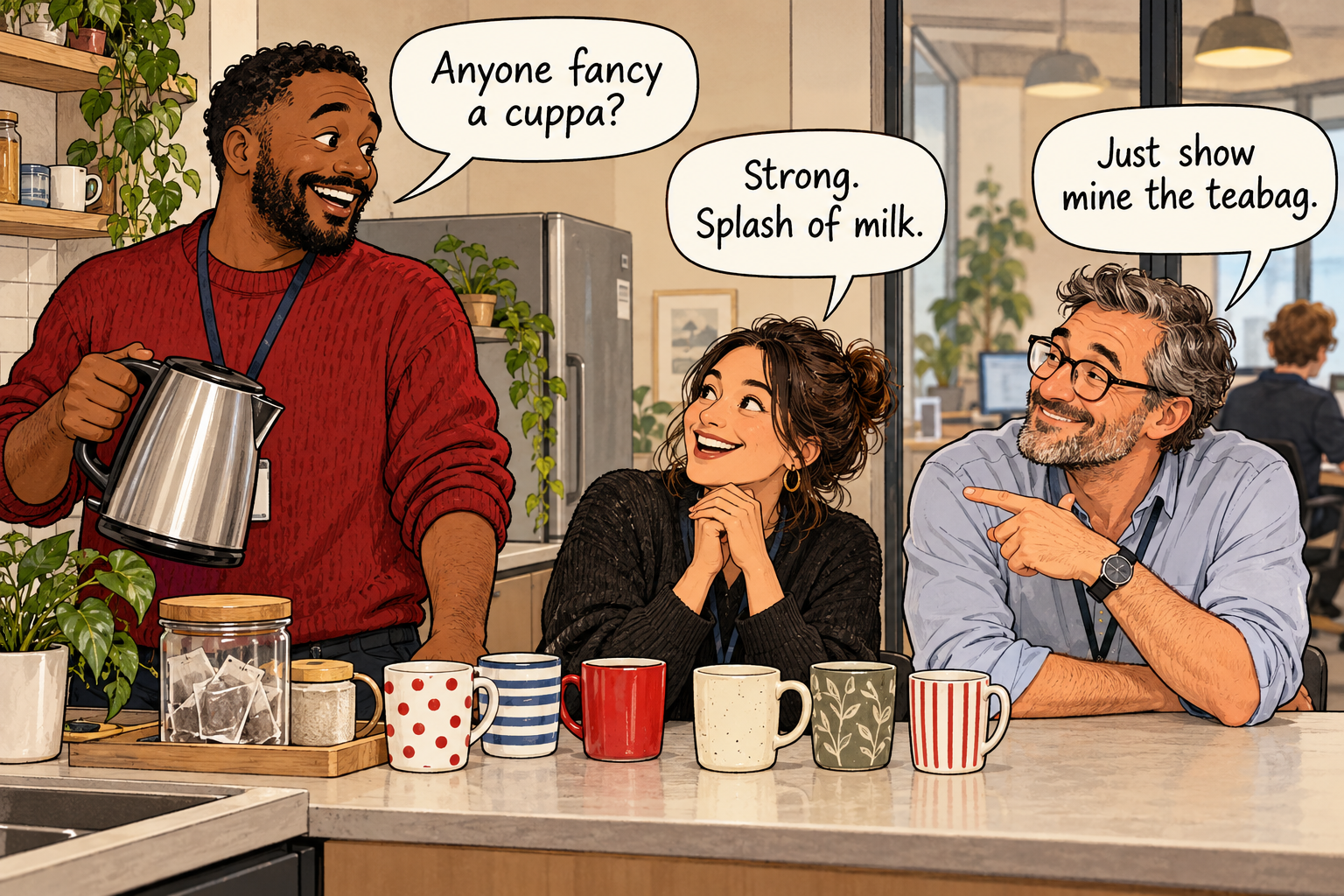
A cuppa usually means tea. “Just show mine the teabag” is a joke about wanting it very weak. Tea rounds can be a small way to connect; ask how people take theirs.
What can I say back?
“Yes, please. Shall I get the next round?”
Your manager asks, "Would you mind having another look?"
Often a request to revise it. Softeners such as "a small concern" or "a bit of an issue" can still signal something that needs attention. Focus on the change being requested, not just how gently it is phrased.
Try"Of course. What specifically needs changing, and when do you need it?"
A meeting ends and you're not sure what was decided.
Disagreement can be indirect ("I wonder whether…"), and decisions sometimes settle in conversations afterwards.
TryA short follow-up email: "Just to confirm what we agreed…"
"Could we have a quick chat?"
It could be two minutes about nothing or an important conversation.
Try"Of course. Anything I should bring?"
You think a colleague's plan is wrong.
Blunt contradiction in front of others can land harder than intended. Leading with agreement and raising the issue as a question often works better.
Try"I like the direction. Could this cause a problem with…?"
A senior colleague signs off "Cheers".
Sign-offs run from "Kind regards" (formal) to "Best" or "Thanks" to "Cheers" (friendly). Openers like "Hope you're well" are common.
TryMatch the sign-off the other person uses.
Months in, colleagues are friendly but you haven't made friends.
It can take time. Friendships grow through coffee, lunch, shared projects, workplace clubs and after-work plans of all kinds.
TrySuggest a coffee or lunch with one colleague at a time.
“We’re having a whip-round for Sam’s leaving present.”
Contributing is optional; ask who is collecting.
“Are you coming to the leaving do?”
A “do” is a social event, not another task on your list.
“My turn for the tea round.”
Ask what people want; joining in is optional.
“He was being a bit of a jobsworth.”
An insult. The person may be following a genuine requirement.
The pub is a neighbourhood meeting place as much as somewhere to drink. A few conventions make it easier, whether or not you drink.
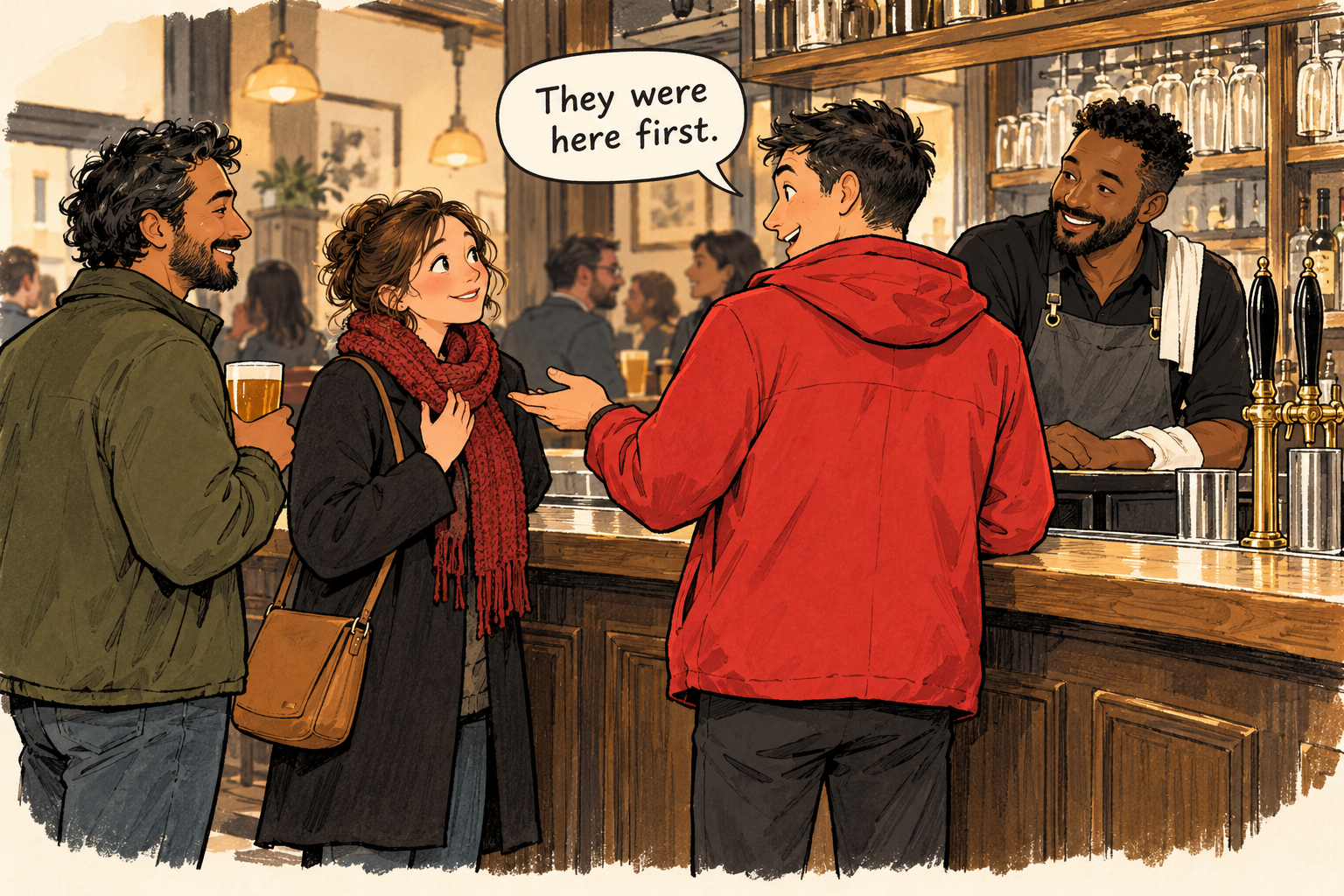
There may be no neat line at the bar, but people still notice who arrived first.
If the bartender turns to you before someone who was already waiting, a small gesture and “They were here first” keeps things friendly.
What can I say back?
“Cheers!”
In many traditional pubs you order and pay at the bar. Some pubs offer table service or app ordering. Tipping at the bar isn't generally expected.
Stand visibly at the bar, make polite eye contact and wait patiently. Avoid snapping your fingers, waving money or shouting for service. If someone arrived before you, a quick "They're next" helps keep things fair.
If you're heading back to the bar, taking your empty glass with you is a helpful gesture. Use a collection point if there is one, and keep the serving area clear.
In some groups, people take turns buying drinks for everyone. Joining a round is always optional. "I'll get my own tonight, thanks" is completely fine.
Plenty of people don't drink, and soft drinks and alcohol-free options are easy to find. You don't need to explain your choice.
Bitter is a style of ale; ales and lagers both cover a wide range of flavours and strengths. Ask what is on tap and whether a small taste is available. A half pint is an option if you want a smaller serving.
Roast meat (or a vegetarian option), roast potatoes, vegetables, gravy and a Yorkshire pudding. Popular pubs get busy, so booking ahead helps.
Many pubs run a weekly quiz. It's a relaxed way to spend an evening with friends or meet new people.
Small social habits that Londoners rarely explain. Light observations, not rules; your experience may differ.
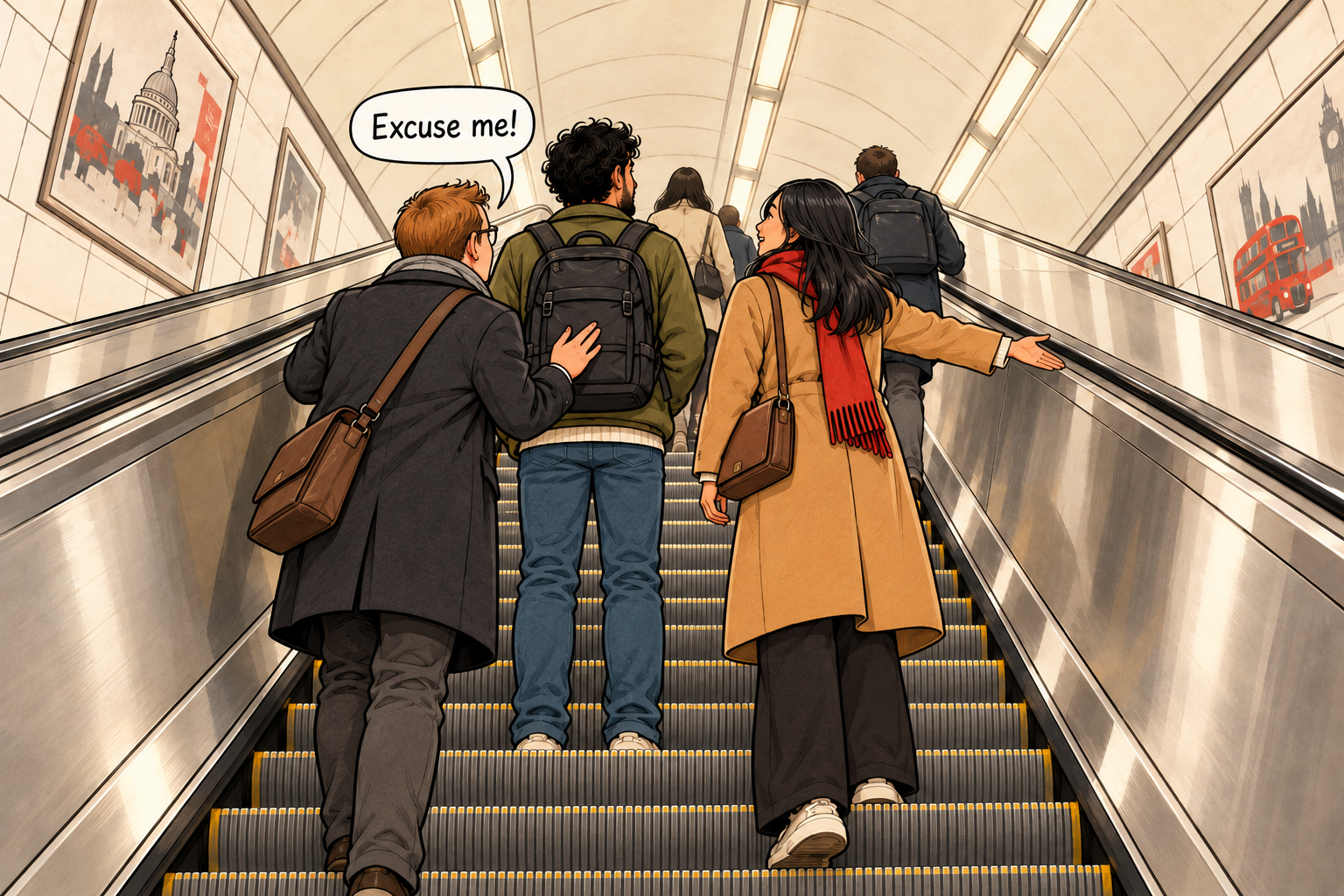
On Tube escalators, stand on the right and leave the left side clear for people walking. Follow signs and staff instructions.
What can I say back?
“Sorry, let me move over.”