Charles II granted the Hudson’s Bay Company its Royal Charter in 1670. Its administration remained based in London for centuries; its head office moved to Canada in 1970.
The charter was an imperial claim to trading rights and territory, not evidence that the land was empty. Indigenous peoples, knowledge and trading relationships were central to the company’s operations. Its story connects London finance and imperial power with lives and lands across northern North America.
1759 to 1763 · Conquest, Quebec and different memories
The Battle of the Plains of Abraham in 1759 and the wider conquest of New France led to the transfer of Canada from France to Britain under the Treaty of Paris in 1763. The battle was a turning point within the Seven Years’ War, not the whole story in a single morning.
For French-speaking Quebec, this is a history of conquest and the survival of language, institutions and identity. For Indigenous nations, European agreements did not erase their own rights or political relationships. A statue celebrating Wolfe can therefore mean something very different to different Canadians.
1867: the British North America Act, enacted at Westminster, created the federation of Ontario, Quebec, Nova Scotia and New Brunswick. Confederation did not instantly create today’s borders or end every British constitutional role.
1931: the Statute of Westminster recognised legislative autonomy. Canada retained a role for Westminster in amending its central constitutional legislation because no domestic amendment formula had been agreed.
1982: the UK’s Canada Act and Canada’s Constitution Act completed patriation, established Canadian amendment procedures and brought the Charter of Rights and Freedoms into the Constitution. Quebec’s government did not agree to the settlement, though it applies in Quebec.
The Crown today · Same person, separate constitutional roles
The monarch is separately King of Canada and King of the United Kingdom. Canada is not governed from Westminster. The Governor General represents the sovereign in Canada, performing constitutional and ceremonial duties, including ensuring there is a government able to command parliamentary confidence.
That distinction explains how Canadians can recognise a familiar monarch while living under a different constitution and political system. Commonwealth membership is another relationship again, not a right to live or work anywhere in the Commonwealth.
First Nations and the Crown · An ongoing relationship
For many treaty First Nations, the Crown relationship concerns enduring agreements, obligations and nation-to-nation relationships, not simply affection for a royal family. The Assembly of First Nations explains treaties as living relationships and stresses that their meaning extends beyond the written text.
Do not assume one Indigenous view: treaty histories and experiences differ, and not all Indigenous nations entered the same agreements. First Nations, Inuit and Métis histories are distinct. Start with Indigenous-led accounts rather than treating the constitutional timeline as the whole story.
Vimy, Dieppe and Juno · Shared war, particular Canadian memories
Vimy Ridge, April 1917: the Canadian Corps’ four divisions fought together in the successful attack. Its place in Canadian remembrance is powerful, but the familiar “birth of a nation” interpretation is not everyone’s account of Canadian identity.
Britain in the Second World War: Canadian forces trained and lived here, including in southern England. Canadians flew in the Battle of Britain, both with the RAF and with the RCAF. Naval and merchant service in the Atlantic also helped sustain Britain.
Dieppe, 19 August 1942: the raid brought devastating Canadian losses. Juno Beach, 6 June 1944: Canadian troops landed in Normandy as part of D-Day.
Newfoundland was a separate dominion during the First World War and did not join Canada until 1949. On 1 July 1916, the Newfoundland Regiment suffered devastating losses at Beaumont-Hamel on the first day of the Somme.
In Newfoundland and Labrador, 1 July is Memorial Day as well as Canada Day. That separate history also explains why London’s Canada Memorial names both Canadians and Newfoundlanders.
Brookwood Military Cemetery, Surrey: a substantial Canadian burial plot and a Canadian Records Building make this a significant place of remembrance.
Bramshott, Hampshire: Canadian camps left a lasting local connection. Canadian First World War graves are found in the churchyards at Bramshott and nearby Grayshott; this is not one single site called “Bramshott Canadian Cemetery”.
Cliveden, Buckinghamshire: the estate hosted a Canadian Red Cross hospital during both world wars. Its memorial garden contains graves of patients and nursing staff.
These are separate journeys beyond central London. Check access with the relevant cemetery or estate, and allow time for a quiet visit rather than treating them as sightseeing stops.
Remembrance · Familiar symbols, a different calendar rhythm
The poppy and the silence on 11 November will be familiar. In Britain, Remembrance Sunday, the second Sunday in November, is also a major focus, including the Cenotaph service. It does not replace Armistice Day.
Families and communities bring different experiences of service, war and loss. Understanding the observance does not require assuming everyone relates to it in the same way.
Andrew Bonar Law was born in New Brunswick in 1858 and became British prime minister in 1922, serving until 1923. He moved to Scotland as a child.
Max Aitken, Lord Beaverbrook, was a Canadian-born newspaper proprietor associated with the Daily Express and a wartime minister responsible for aircraft production. His career shows how media ownership, money and political influence crossed the Atlantic.
Thomson and Black · Canadian money in Fleet Street
Roy Thomson expanded into British newspapers, including The Sunday Times and The Times. Conrad Black, through his companies, later controlled the Telegraph group.
These histories of ownership and influence help explain why Canadian business names recur in discussions of the British press.
The Reichmanns and Mark Carney · Skyline and financial institutions
The Toronto-based Reichmann family company, Olympia & York, was central to the development of Canary Wharf. The story includes ambition, the 1992 property collapse and recovery.
Mark Carney served as Governor of the Bank of England from 2013 to 2020, after leading the Bank of Canada. He became Canada’s prime minister in March 2025. It is a particularly visible example of public-service careers crossing the Atlantic.
For a complete afternoon out, try our three London routes: royal London, docks and skylines, or markets and migration. The Canadian landmarks below explain what you’ll find along the way.
A self-guided route in two parts. The first three stops fit a central London walk. Canada Water, Canary Wharf and Greenwich form an east London extension using public transport.
1 · Canada House
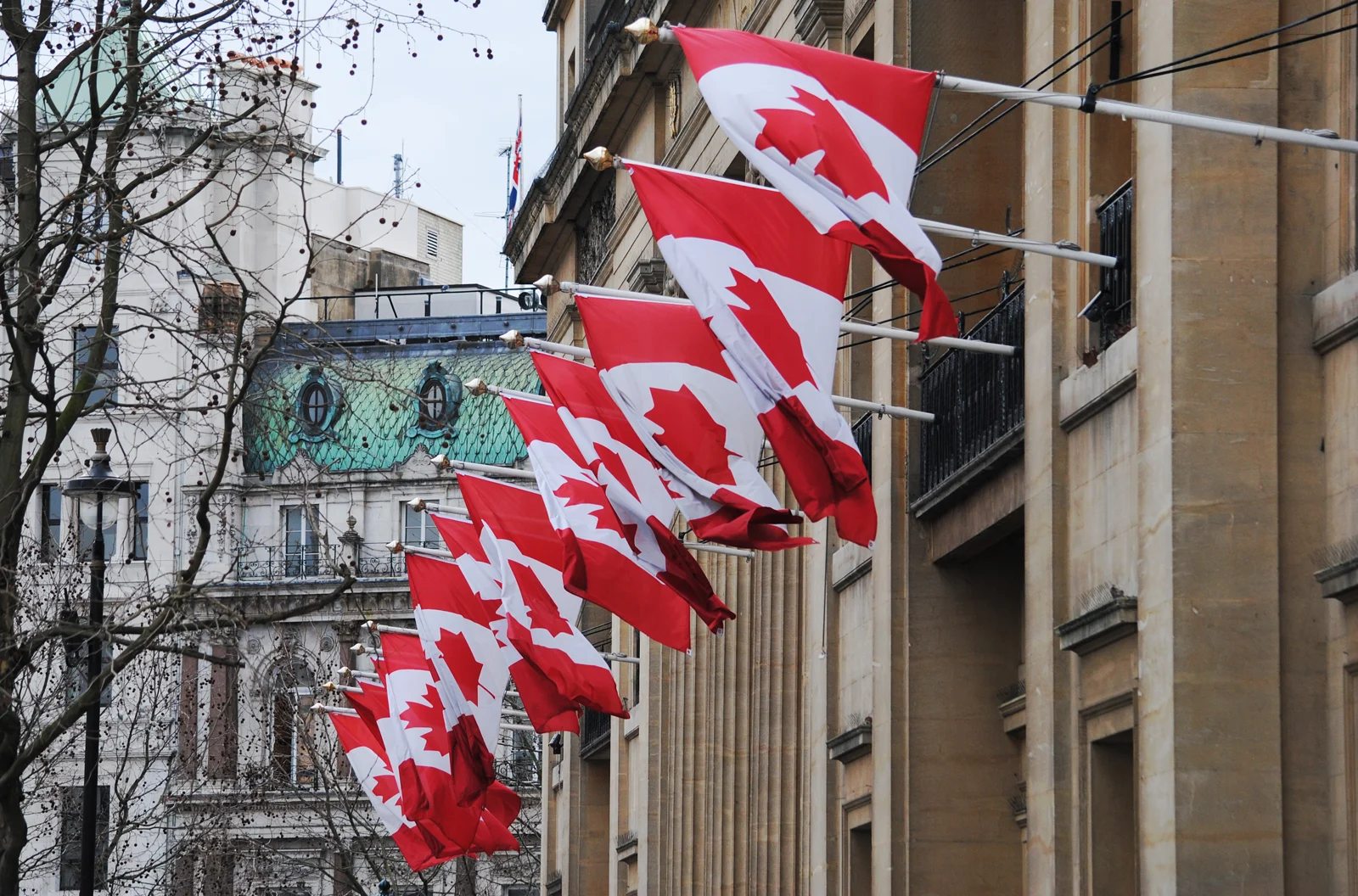
Start on Trafalgar Square’s west side. Canada’s diplomatic home here opened in 1925. Look for the Canadian presence in one of London’s most recognisable public spaces; check official access or exhibition arrangements before expecting to enter.
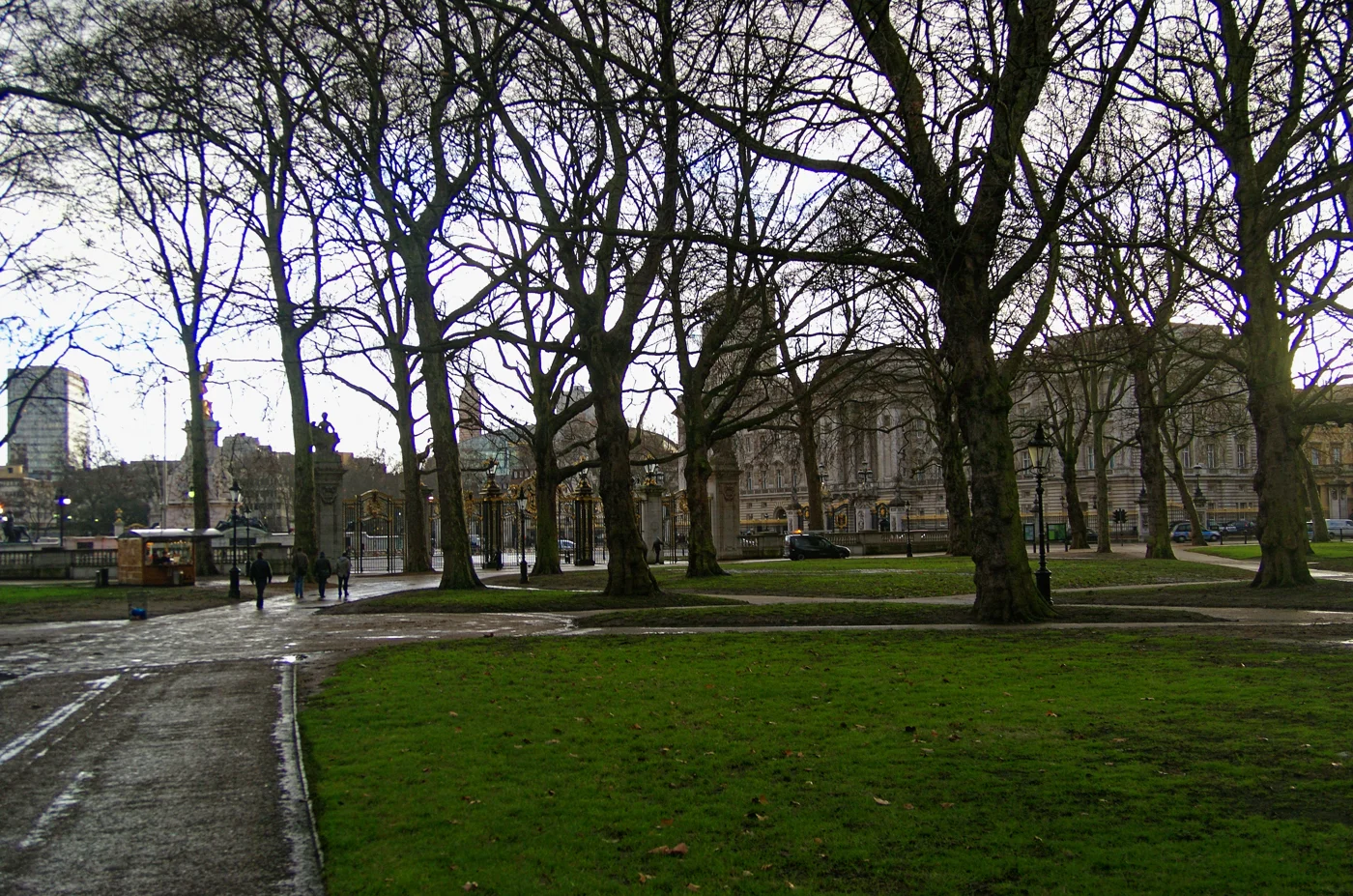
Walk along the Mall towards Buckingham Palace. Canada Gate forms an entrance to Green Park and was Canada’s contribution to the Queen Victoria memorial scheme. Look at the provincial crests in the metalwork.
A short walk inside Green Park brings you to Pierre Granche’s memorial, unveiled in 1994. Granite, bronze maple leaves and flowing water commemorate Canadian and Newfoundland service in Britain during the world wars.
Rotherhithe’s Canada Water preserves the name and part of the basin of Canada Dock, within the former Surrey Commercial Docks. Timber arriving from Canada helped supply London’s growth. The waterside walk makes the trading connection tangible.
Canada Water station is on the Jubilee line, one stop west of Canary Wharf. Start the east London extension here, then take the Jubilee line one stop east to Canary Wharf.
From Canada Water, take the Jubilee line one stop east to Canary Wharf and walk to One Canada Square. The 1991 tower gives the Canadian development story a visible landmark. Enjoy the exterior and surrounding estate; do not assume the office tower is an open public viewing platform.
Continue towards Greenwich on the DLR from Canary Wharf. Cutty Sark is the town-centre stop; Greenwich DLR is another option. For a memorable walking approach, get off at Island Gardens and use the Greenwich Foot Tunnel beneath the Thames. Check TfL service updates and tunnel lift access before setting out. The statue near the Royal Observatory was a Canadian gift, created by Robert Tait McKenzie and unveiled on 5 June 1930. Read it alongside the conquest briefing above, rather than as an uncomplicated national celebration. The park approach is uphill.
The relationship is active as well as historical. The Canada-UK Trade Continuity Agreement, in force since April 2021, preserved much of the preferential trading relationship after Brexit. Businesses, universities and research teams maintain substantial connections.
Both countries are NATO allies and members of Five Eyes, the intelligence-sharing partnership with Australia, New Zealand and the United States. Both also belong to the Commonwealth, a voluntary association distinct from those defence and intelligence arrangements.
Use these as routes into the existing guides. Commonwealth ties do not remove eligibility requirements, and this cultural overview does not replace current application guidance.
Voting in Britain
Qualifying Commonwealth citizens can register subject to residence, age and immigration-status requirements. Canadian citizenship alone is not the whole test.
“Canadian, actually. I’m from…” is enough. There is no need to apologise for your accent or make someone feel foolish for guessing. You can turn it into a conversation: “Have you been to Canada?”
There is no single Canadian accent or experience. Sharing where you grew up, the languages you speak or what brought you here gives people something more interesting than a nationality guessing game.
Familiar words and a taste of home
Washroom, toque, a mickey and a hydro bill may need translating. The Canadianisms section handles the words that can leave British friends puzzled.
Canada Day, Thanksgiving, hockey and poutine can be ways to keep a connection with home while building a life here. Check the year’s programme and venue rather than assuming every celebration is in Trafalgar Square.
Canadian Thanksgiving falls on the second Monday in October. It is not a UK bank holiday, so plan your celebration around the working week. Victoria Day is not a UK bank holiday either: sharing a monarch’s history does not mean sharing a day off.
Useful invitation wording: “Canadian Thanksgiving, in October. Come hungry.” Your British friends do not need a family tradition to enjoy joining yours.
Leaving Britain: where people built lives in Canada
People left England, Scotland, Wales and Ireland for different reasons: land, wages, family, upheaval and sometimes coercion. Ireland was part of the United Kingdom during the nineteenth-century famine, but Irish migration has its own identity and history. The places people reached were already Indigenous homelands; settlement is also part of Canada’s colonial history.
Scottish journeys: Gaelic communities and wider settlement
Scottish migration included Highland families affected by clearances, poverty and changing land use, alongside Lowland workers, professionals and merchants. Chain migration helped relatives and neighbours settle near people they knew.
Pictou, Antigonish and Cape Breton became important Gaelic centres. Scottish Gaelic, fiddle music and community traditions remain visible in Nova Scotia. Ontario’s Glengarry and Bruce counties were other Gaelic settlement areas.
English and Welsh migration: land, skills and family networks
English and Welsh migrants settled across Canada in towns, farming districts and industrial centres. Work and family contacts often determined the destination more than nationality alone.
Welsh emigration included skilled industrial workers, while chapels, language and music helped sustain connections. Some routes were indirect, including Welsh families moving from Patagonia to Canada.
Irish migration: before, during and after the Famine
Irish migration to Canada included both Protestant and Catholic communities. The Great Famine of 1845 to 1852 drove a devastating movement of people seeking survival; disease and quarantine marked many journeys.
Quebec and Atlantic ports were gateways, with settlement continuing into towns and rural communities elsewhere. A port of arrival is only the first step in a family’s Canadian story.
Hamilton’s iron and steel industries drew workers seeking wages and a future for their families. Scottish connections sit within a wider British, Irish and international migration story.
Hamilton Civic Museums documents the industrial boom that drew central and eastern European labour migrants as well. The useful connection is between people, recruitment, skills and neighbourhoods: one industry could bring many communities into the same city.
British Home Children: migration without an adult’s choice
From 1869, more than 100,000 children were sent from Britain to Canada through organised child migration schemes. Many were placed in farm or domestic work. Their circumstances and treatment varied, and family separation is central to this history.
Library and Archives Canada provides records for descendants tracing these journeys. This belongs alongside adult migration, with the children’s limited choice made clear.
During and after the Second World War, many women who had married Canadian service personnel crossed the Atlantic with their children. Most were British, though families came from other European countries too.
Halifax’s Pier 21 received many of them before onward train journeys to new homes. Marriage and family reunion could take someone from a familiar British town to a very different Canadian landscape.